The First Page Is a Place to Begin, Not a Promise
Treating a first draft as a working surface makes starting feel less loaded and gives you a clear way to shape rough material into a finished piece.
The common mistake with a first draft is asking it to prove the project will be good. That turns a blank page into a verdict: each sentence must seem worth keeping before you have enough material to judge it, and beginning can stall under the pressure. A first page works better as a surface for making choices visible, not a promise about the finished piece.
This distinction matters across forms. A short story may begin with a scene that later disappears; an essay may open on a question it eventually answers differently; a drawing may start with lines that help locate the subject. In each case, the early work gives you something to respond to. It is not yet a contract with yourself or an audience.
What the first draft does
A first draft is an initial arrangement of material. “Draft” means a version open to revision, not a lower-quality final product. It can hold an image, an argument, a sequence of events, or a rough description of what you want to make. Its job is to let those parts exist together long enough for you to see what they might become.
That makes the draft a working surface. A carpenter’s bench does not have to resemble the finished chair; it gives the pieces room to be placed, adjusted, and joined. Likewise, a first page can contain a note to yourself, an awkward sentence, a question, or a gap you have not solved. Those marks are useful when they help you see what is missing or interesting.
The surface is not an excuse to avoid craft. It simply separates two kinds of judgment that often interfere with each other. While generating material, you are asking, “What could be here?” During revision, you ask, “What belongs, and how should it work?” Keeping those questions distinct gives each one room to do its job.
Why does starting feel like a promise?
Starting can feel binding when you confuse the first version with a public statement of your ability or intentions. If the opening is clumsy, it may seem to predict the whole project. But an opening records only what you could make at that point, with the information and attention you had then.
The pressure can also come from imagining the finished work too early. You may picture a polished chapter, a resolved painting, or a piece that earns an imagined reader’s approval, then compare that mental image with a blank page. The comparison is unfair: one is a complete possibility in your mind, while the other has not yet had a chance to take shape.
Try changing the question from “Can I make this good?” to “What can I put here that will help me make the next decision?” That might be a paragraph describing the room where a scene takes place, a list of competing claims for an essay, or a rough outline of a composition. The answer does not need to settle the work’s value; it only needs to give you a workable next move.
How should I use a rough opening?
Use the opening to approach the material from whichever side feels available. You do not have to begin at the beginning of the finished work. If the central scene is clear but the opening is not, draft the scene first; if you can hear a character’s voice, write a line of dialogue; if your subject is abstract, describe one concrete instance of it.
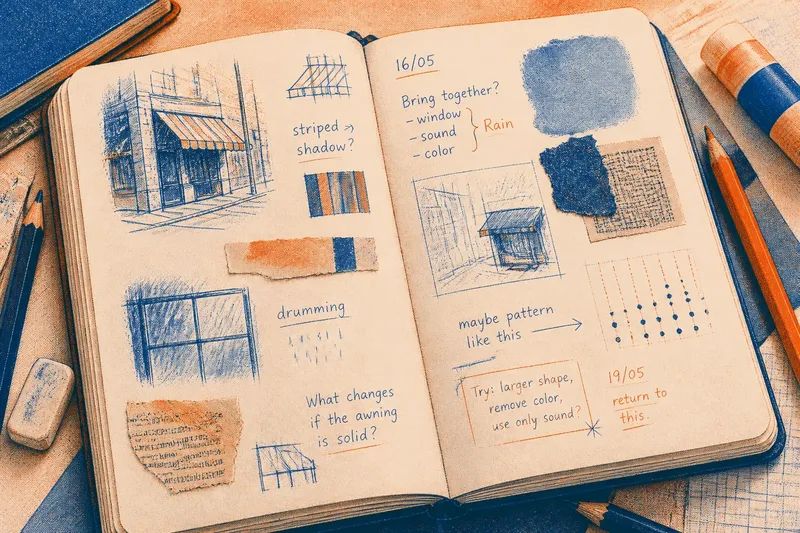
Leave visible signs of uncertainty rather than disguising them as polished prose. Bracket a missing detail, add a note such as “[why does she leave?],” or write two possible opening lines. In a digital document, comments or highlighted text can hold questions without forcing you to answer them immediately. On paper, a margin note serves the same purpose.
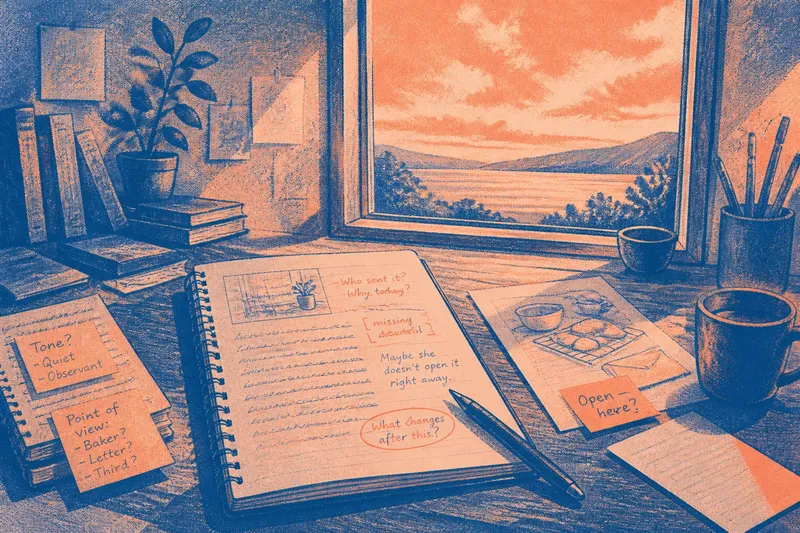
Say you want to write a short story about a baker who receives an unexpected letter, but you do not know how the story should open. You write a rough scene in which the letter rests beside a cooling tray, then mark “Who sent it?” and “Why today?” as questions; later, those notes may help you choose the story’s tension and viewpoint. The observable result is not a finished opening but a scene with specific details and decisions you can work on.
One caution: do not make the roughness so vague that it gives you nothing to examine. “Write something about change” leaves few handles; “describe the coat still hanging by the door after its owner has moved” offers an image, an object, and a possible question. Specificity creates material without deciding what the finished piece must mean.
When should I revise the first page?
Revise the first page when you understand more about the work than you did when you wrote it. That may happen after drafting a later scene, discovering the essay’s central claim, or learning how the visual composition needs to balance. At that point, the opening can be judged by the work it actually introduces rather than by guesses about where it might go.
There is no need to protect early wording just because it took effort to make. Keep what helps the reader enter the piece, and move or remove what no longer serves that purpose. A strong image from the first paragraph might belong in the middle; a carefully phrased explanation might turn out to be a note for you rather than something the reader needs.
Still, delaying all attention to the opening can create its own problem. If you cannot tell what the project is about, pause long enough to write a temporary sentence describing what you are trying to explore. Treat that sentence as a navigation aid, not as a final thesis. Continue drafting, then revisit it when the material gives you better evidence of the work’s direction.
What if the first page is bad?
A bad first page is information, not a diagnosis of your ability. Ask what kind of difficulty it reveals: perhaps the subject is too broad, the scene lacks a clear point of view, or the tone is not yet settled. A useful revision begins by naming the problem, because “this is bad” gives you no particular action to take.
Try a small, targeted response. If a paragraph explains too much, mark the sentence that carries the main idea and see whether the rest can become scene, example, or a later passage. If an opening image feels unrelated, list what it makes you wonder about; either connect one of those questions to the project or set the image aside. The purpose is not to defend every rough choice but to learn what it can tell you.
Sometimes the right response is to write a different beginning without deleting the first. Save the original in a separate file or duplicate the page, then try another entry point. Keeping both versions lets you compare what each one makes possible, rather than treating one attempt as an irreversible decision.
How do I keep a draft from sprawling?
Give the draft a temporary boundary. Decide what piece of the project you are working on now: one scene, one claim, one page of visual studies, or one question you want to explore. A boundary is not a pledge to produce a particular quality or length; it is a way to keep the working surface usable.
- Write a temporary purpose in plain language: “I am trying to show why the neighbor returns the key.”
- Mark questions that need more thought instead of stopping to answer every one.
- Use a note such as “[research the ferry route]” when a detail calls for checking later.
- Keep alternate phrases or scenes in a separate place so they do not interrupt the current version.
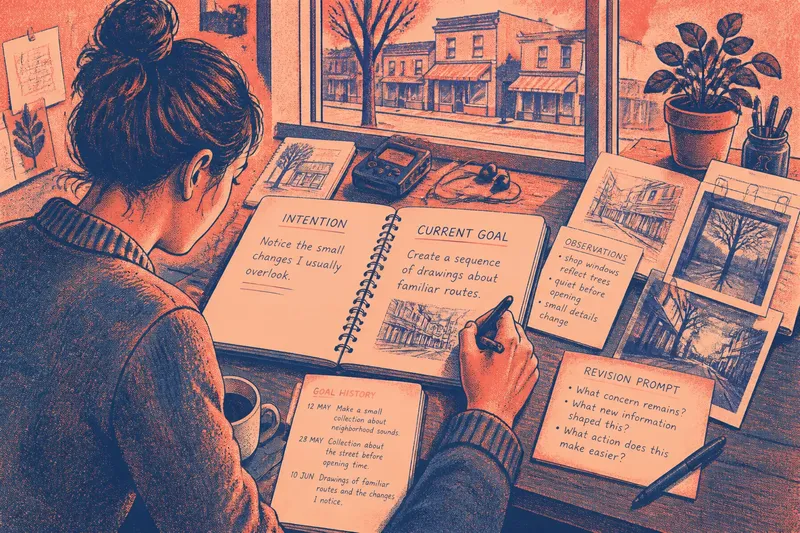
- At the end of a session, leave one specific note about the next decision, such as “choose whose point of view carries the scene.”
These practices make the draft easier to re-enter and easier to revise. They also help you distinguish a productive question from a distraction. If an unresolved detail changes the meaning of the scene, note it prominently; if it is a small fact you can check later, record it and keep working.
What should I do when I feel stuck?
Look for the smallest action that would make the material more visible. You might write a character’s answer to a question, sketch the shape of a paragraph, list what two sides of an argument disagree about, or describe the first physical detail you notice in a setting. You are not required to solve the whole work before adding the next piece.
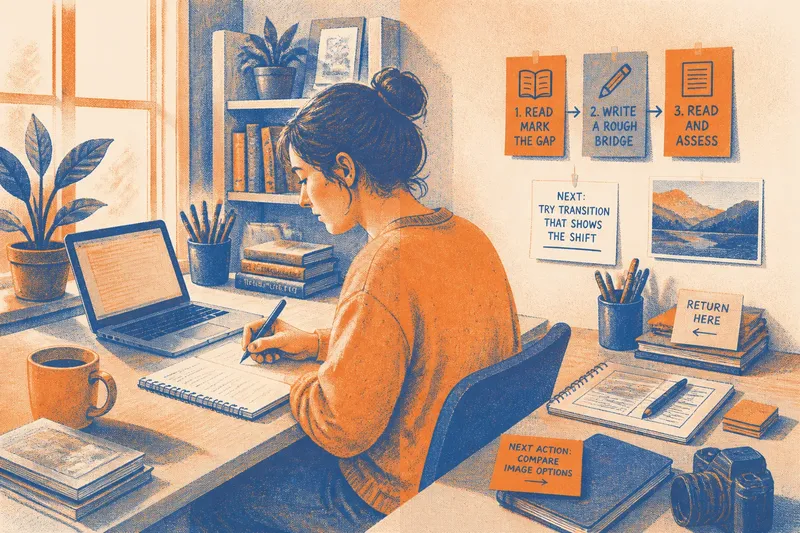
If you cannot tell what to add, inspect what is already on the page. Underline a phrase that has energy, circle an unexplained assumption, or draw an arrow where the sequence seems to skip a beat. These are observations, not grades. Each one points toward a possible action: expand the phrase, question the assumption, or add the missing transition.
When the project needs information you do not yet have, distinguish that need from ordinary uncertainty. Write down what must be checked, then decide whether you can continue with a clearly marked placeholder. For matters that depend on a label, manufacturer instructions, or local rules, consult the relevant source before presenting a detail as fact; the note can remain provisional until then.
How do I know a draft is ready?
A first draft is ready for revision when it contains enough connected material to let you make meaningful choices. That does not mean every section is complete or every question is answered. It means you can see a shape, a sequence, or a set of ideas to work with instead of facing only isolated possibilities.
For a story, you might have the main events in a rough order, even if the transitions are thin. For an essay, you might have a claim and several passages that complicate it, even if the conclusion is still uncertain. For a visual piece, you might have a composition that shows how the major elements relate, even if details remain unresolved.
When you can name what the work is trying to do and identify what needs attention next, the draft has served its first purpose. The next version may change its opening, structure, or central idea. Let the first page remain evidence of where the work began, not a pledge that it must end there.
For your next creative draft, choose one concrete entry point and make it specific enough to respond to: an object on a table, a claim you are unsure about, or a line of dialogue you can hear. Add questions where knowledge is missing, and let the page hold them while you continue. The first page is useful when it gives you something real to shape, even if the finished work later begins somewhere else.