From Sketchbook Margins to the Working Notebook
A working notebook helps loose creative fragments become usable material without turning unfinished thoughts into a polished record or rigid plan.
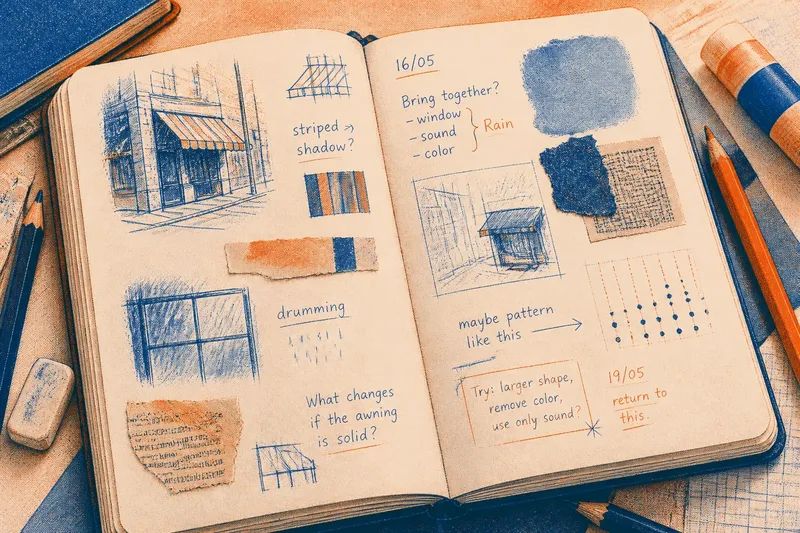
The common mistake with a working notebook is treating it like a miniature archive: every page should be tidy, complete, and ready to show. That expectation can cost you useful fragments, because a half-drawn shape or an awkward phrase gets dismissed before you can see what it might become. A working notebook is a place to keep material in motion.
Its role is different from a journal written to preserve a finished account. You can leave gaps, revise in the margin, and return to a thought without explaining it to an imagined reader. The notebook’s history is less a straight line than a change in use: private pages have served as places to notice, collect, test, and carry unfinished ideas.
From margins to pages
Before a notebook becomes a recognizable tool for creative work, its earliest form may be a scrap of paper beside the work itself. A sketchbook margin can hold a color note, a thumbnail drawing, or a question raised while looking at a reference. These marks are small because they answer to the moment, not to a plan for a finished piece.
As fragments accumulate, a bound notebook offers continuity. The page beside one idea can hold a variation, a response, or a detail noticed later. This does not make the notebook a complete record of a person’s creative life; it makes it a surface where thoughts can meet. The shift is practical: instead of asking each fragment to stand alone, you give it a place among other fragments.
Say you are sketching a street-corner scene and keep drawing the same awning without knowing why. You could add a note in the margin—“striped shadow,” perhaps—and a tiny shape beside it. Later, that mark may suggest a rhythm or color for a separate drawing. The observable result is not a finished composition but a fragment you can recognize and develop.
Choose a notebook for use
Start with a notebook that suits the marks you expect to make. If you work with pencil, loose notes, and small diagrams, an ordinary unlined notebook may be enough. For ink, collage, or watercolor, paper texture and thickness matter more; try a few marks on a spare page before committing to that medium.
A bound book keeps pages together, while a pad or loose sheets make rearranging and removing material easier. Neither format is more creative. Choose based on whether you want ideas to remain in sequence or whether you often need to move pieces around. A pocket notebook can catch observations away from your desk; a larger one leaves room for sketches and handwritten notes on the same spread.
Keep the setup modest. A pencil, an eraser, and one pen may be enough; add a glue stick or colored pencil only if those tools help you collect material. Like a kitchen counter, the notebook works best when there is enough clear space to use it, not when every corner is filled with equipment.
Collect before organizing
When a phrase, image, question, or possible direction catches your attention, record it in the form that is easiest at the time. Use a few words, a rough drawing, a swatch, or a reference note. Include enough context to understand the fragment later: a place, a material, a mood, or the question that prompted it.
Do not force every entry into the same format. A short line of dialogue may sit beside a diagram; a torn paper sample may face a list of possible colors. The notebook is not a polished record, so inconsistency is useful when it preserves how the idea first appeared. If a reference image or found text belongs to someone else, note its source so you can distinguish it from your own material.
Leave some breathing room around a fragment when you can. The blank space gives you somewhere to add a response later, but it need not become a rule. If a page is already full, continue on the next one and add a small pointer, such as “awning note, previous page.”
Return and make connections
When you reopen the notebook, scan for marks that still attract your attention. A small symbol, repeated word, or unfinished diagram may matter more now than it did when you wrote it. Circle, underline, or add a date beside the fragments you want to revisit; avoid rewriting the whole page just to make it look consistent.
Next, place a new note beside the old one. Ask a specific question: what changes if the shape is larger, the phrase is spoken by someone else, or the color is removed? A working notebook becomes active when you make a response, not simply because you reread it. Keep the new response visibly distinct so you can tell the original spark from the later interpretation.
Imagine you find three separate notes about rain: a penciled window shape, the word “drumming,” and a blue-gray color swatch. You might draw them together on a fresh page, then note which combination feels worth exploring. The result is a candidate for further work, not proof that the pieces belong together. If the connection feels forced, leave the fragments separate.
Keep the record unfinished?
How is a working notebook different from a journal?
A journal often preserves a continuous account, while a working notebook can be fragmentary and organized around creative material. You can use both, but the notebook does not need a complete narrative or polished entries.
Should I date every page?
Dates help when timing matters, such as tracking how an idea changes or remembering where an observation came from. If exact dates interrupt your flow, date only the entries that need that context.
What if a page looks messy?
Messiness is not a problem unless it prevents you from finding or reading the material. Add a clear note, arrow, or margin label where it helps; do not spend time disguising revisions that still make sense.
When should a fragment become a project?
Move it into a project when you can name a next action, such as making a larger sketch or testing a phrase in a draft. The fragment can remain in the notebook as a source, while the project develops elsewhere.
Let the notebook stay open
As your pages fill, make them easier to revisit without turning them into a display. Add a simple index at the front if you have recurring subjects, or write a few keywords on the page edges. Keep the index selective: it should point toward material, not summarize every mark.
Set aside fragments that no longer interest you without declaring them useless. Some will remain private notes; others may become ingredients for a larger work, and some may simply record what held your attention. The working notebook earns its place by making those possibilities visible while they are still unfinished.
For a working notebook to support creative progress, let its pages show both the first impression and the later response. That visible distance helps you notice how your attention changes. You can then choose what deserves further work without demanding that every thought turn into a finished piece.